
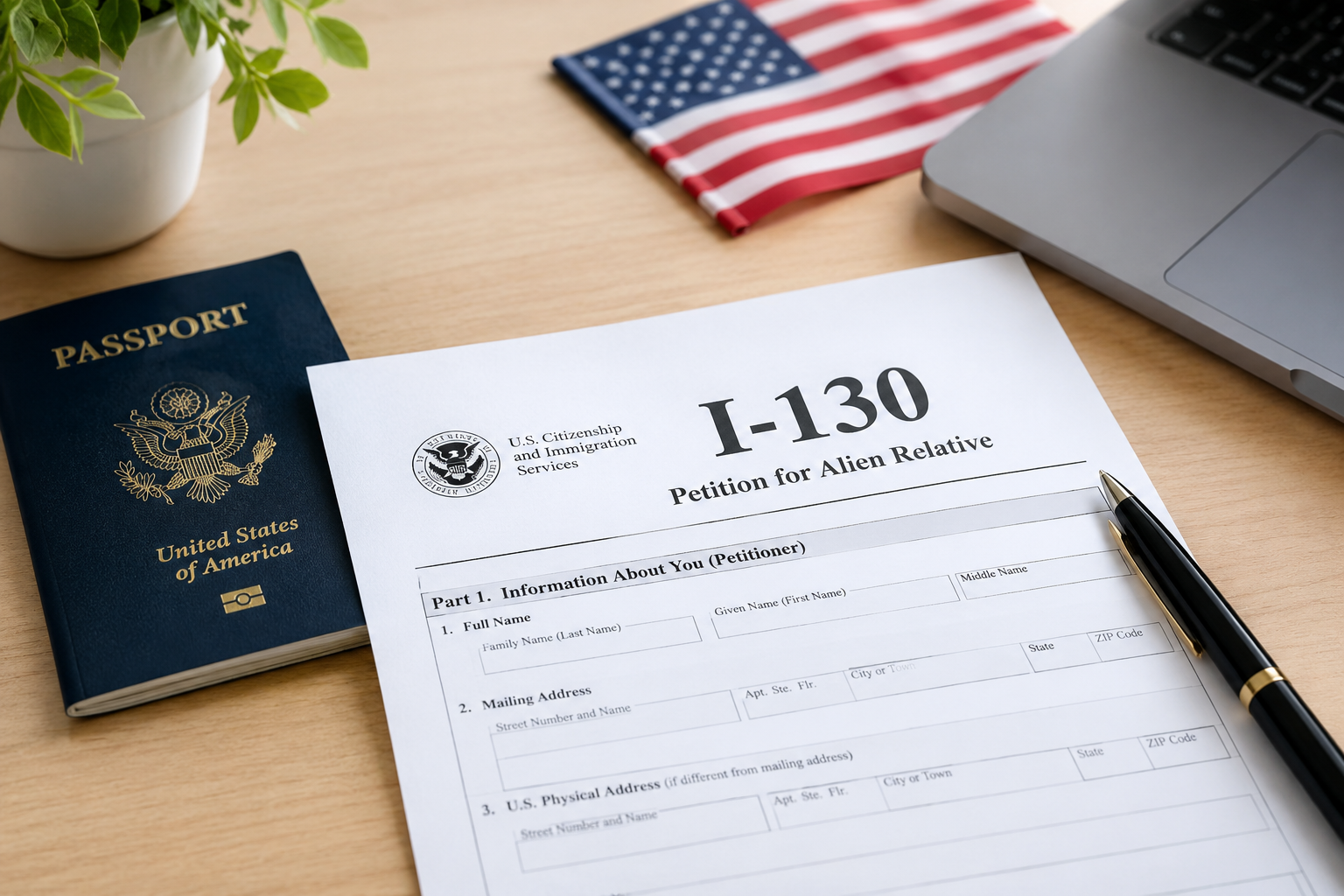
If you’re a U.S. citizen or green card holder who wants to bring a family member to the United States, Form I-130 is almost always where the process starts. It’s a short form, but a lot rides on it. A small mistake can cost you months or even a denial.
This guide explains what the I-130 petition does, who can file it, what to include, and what happens after USCIS approves it.
What Is Form I-130?
Form I-130, officially the Petition for Alien Relative, is how a U.S. citizen or lawful permanent resident (green card holder) asks U.S. Citizenship and Immigration Services (USCIS) to recognize a family relationship for immigration purposes.
In immigration language, the person filing is the petitioner. The relative they’re sponsoring is the beneficiary.
The I-130 does not give your relative a visa, a green card, or permission to live or work in the U.S. It only proves that the family relationship is real and qualifies. Your relative then takes a second step to actually immigrate. If you want a quick overview first, our short explainer on what an I-130 is covers the basics.
Who Can File an I-130 Petition?
Your immigration status decides which relatives you can sponsor.
U.S. citizens can petition for:
- A spouse
- Unmarried children under 21
- Unmarried sons and daughters age 21 or older
- Married sons and daughters of any age
- Parents (the citizen must be at least 21)
- Brothers and sisters (the citizen must be at least 21)
Green card holders can petition for:
- A spouse
- Unmarried children under 21
- Unmarried sons and daughters age 21 or older
Green card holders cannot file for parents, siblings, or married children. That surprises many families. If a permanent resident later becomes a citizen, more options open up.
One more limit: the I-130 is not for a fiancé(e). Fiancés use a different process, the K-1 visa.
Immediate Relatives vs. Family Preference Categories
This distinction affects how long your family will wait.
Immediate relatives are the spouses and unmarried children under 21 of U.S. citizens, and the parents of adult U.S. citizens. There’s no annual cap on visas for this group. Once the I-130 is approved, a visa is available right away.
Family preference categories cover everyone else, such as adult children and siblings of citizens, and spouses and children of green card holders. Congress limits how many visas go out each year in these categories, so approved petitions wait in line. Your place in line is your priority date, which is the day USCIS receives your I-130.
For a broader look at how these categories fit together, see our family-based immigration guide.
How the I-130 Fits Into the Green Card Process
Think of it as three stages:
- File the I-130. USCIS decides whether the relationship qualifies.
- Wait for a visa number, if needed. Immediate relatives skip this. Everyone else waits based on category, country, and priority date.
- Apply for the green card. This happens one of two ways:
- Adjustment of status (Form I-485), if your relative is already in the U.S. and eligible to apply from inside the country.
- Consular processing, where your relative attends an immigrant visa interview at a U.S. embassy or consulate abroad.
For some immediate relatives already in the U.S., the I-130 and I-485 can be filed together. That’s called concurrent filing. It can save time, but the rules on who is eligible to adjust status are strict. Being in the U.S. isn’t enough. Your relative’s entry, status history, and any past violations all matter.
What Does It Cost to File Form I-130?
USCIS currently charges $675 for a paper filing and $625 when you file online. You pay a separate fee for each relative you sponsor, and the fee is generally not refunded, even if the petition is denied. There is no premium processing for the I-130, so paying more won’t speed up the decision.
The I-130 fee is only the first cost. Later steps carry their own fees, such as the green card application or consular fees, plus the medical exam. Fees change, so confirm the current amount on the USCIS website before you file.
Documents You’ll Usually Need
What you submit depends on the relationship. Most petitions include the following.
Proof of the petitioner’s status
- A copy of your U.S. passport, birth certificate, or naturalization certificate, or
- A copy of both sides of your green card
Proof of the relationship
- Spouse: marriage certificate, plus proof that any earlier marriages ended
- Child: the child’s birth certificate showing you as a parent
- Parent: your own birth certificate showing your parent’s name
- Sibling: birth certificates showing you share at least one parent
Extra evidence for marriage cases
Marriage petitions get more scrutiny, because USCIS wants to know the marriage is genuine. Strong evidence includes joint leases or mortgages, shared bank accounts, insurance policies listing each other, utility bills, travel records, and photos across time. Our guide on applying for a green card through marriage goes deeper on what officers look for.
Other items
- Passport-style photos in spousal cases
- Name change records, if any names differ across documents
- Certified English translations of any document in another language
A Practical Example
Maria is a U.S. citizen who married Daniel, a citizen of Colombia, two years ago. Daniel is living in Colombia. Maria files an I-130 for Daniel as his immediate relative. After USCIS approves it, the case moves to the National Visa Center, and Daniel completes his immigrant visa process at the U.S. embassy.
Now compare Luis, a green card holder who wants to sponsor his married daughter. He can’t. Permanent residents can’t petition for married children. If Luis becomes a U.S. citizen later, he could then file for her, though she’d fall into a preference category with a longer wait.
The two cases involve the same form and very different timelines.
Common Mistakes That Delay or Sink an I-130
Most problems come from small errors that were easy to avoid.
- Signature problems. USCIS now has clear authority to deny a filing with an invalid signature, even after accepting it, and it may keep your fee. Sign paper forms by hand in ink, and make sure every person who must sign has done so.
- Using the wrong fee or an outdated form. Either can get your package rejected.
- Leaving out marriages or children. If a name is missing from the form, an officer can treat it as an inconsistency, even if you didn’t mean to hide anything.
- Weak proof of the relationship. A marriage certificate alone often isn’t enough.
- Mismatched details. Different spellings, dates, or names across documents invite Requests for Evidence (RFEs). An RFE is a USCIS letter asking for more proof.
- Assuming approval means status. An approved I-130 doesn’t allow your relative to live or work in the U.S.
- Ignoring past immigration problems. Overstays, prior removals, or criminal history can create serious barriers at the green card stage, even when the I-130 is approved.
- Ignoring the marriage fraud bar. A person who entered a sham marriage in the past can be permanently barred from family-based petitions. This is a serious area that calls for legal review.
What Happens After You File
USCIS sends a receipt notice, usually within a few weeks. Later you may receive an RFE, an interview notice, or an approval. Processing times vary by petition type and USCIS workload, so check the USCIS processing times page for the current range instead of relying on old estimates.
Once approved, immediate relatives move on to the green card stage. Preference-category relatives wait for their priority date to become current on the State Department’s monthly Visa Bulletin.
If USCIS denies the petition, you may have options, such as filing an appeal or a motion, or filing a new petition with stronger evidence. Deadlines are short, so talk to an attorney quickly.
Later steps bring other issues. Affidavit of Support requirements and public charge rules can affect your relative’s green card case, and our post on who is subject to the September 2026 public charge rule explains who may be affected.
Do You Need a Lawyer to File an I-130?
No law requires it, and many straightforward cases are filed without one. But a lawyer helps most when your case includes:
- A prior marriage, a prior denial, or a gap in status
- An overstay or unlawful entry
- Any arrest or criminal history
- A family member abroad with a complicated history
- A marriage with limited paperwork
- Uncertainty about whether adjustment or consular processing is the right path
Frequently Asked Questions About Form I-130
Yes, USCIS allows many I-130 petitions to be filed online through a USCIS account, and the online fee is lower. Eligibility depends on the petition type, so check the current USCIS instructions.
No. The I-130 alone gives no work permit or travel permission. Rights to work or travel usually come with a later application, and only if your relative qualifies.
If the I-130 is still pending, you can ask USCIS to change how the case will be processed, for example from consular processing to adjustment of status, or the reverse, in some situations.
The category can change, and that may shorten the wait. Let your attorney or USCIS know about the change so the case is handled correctly.
Take the Next Step With Confidence
Form I-130 looks simple on paper, but the details decide how smoothly a case moves. If you’re not sure which category fits, how to prove your relationship, or what to do about a complication in your history, we can help.
At E-Z Immigration, we walk families through each step of the process. Learn more about our family immigration services, or reach out to our team to talk through your situation.
This article is general information, not legal advice. Immigration rules and fees change, and every case is different.