
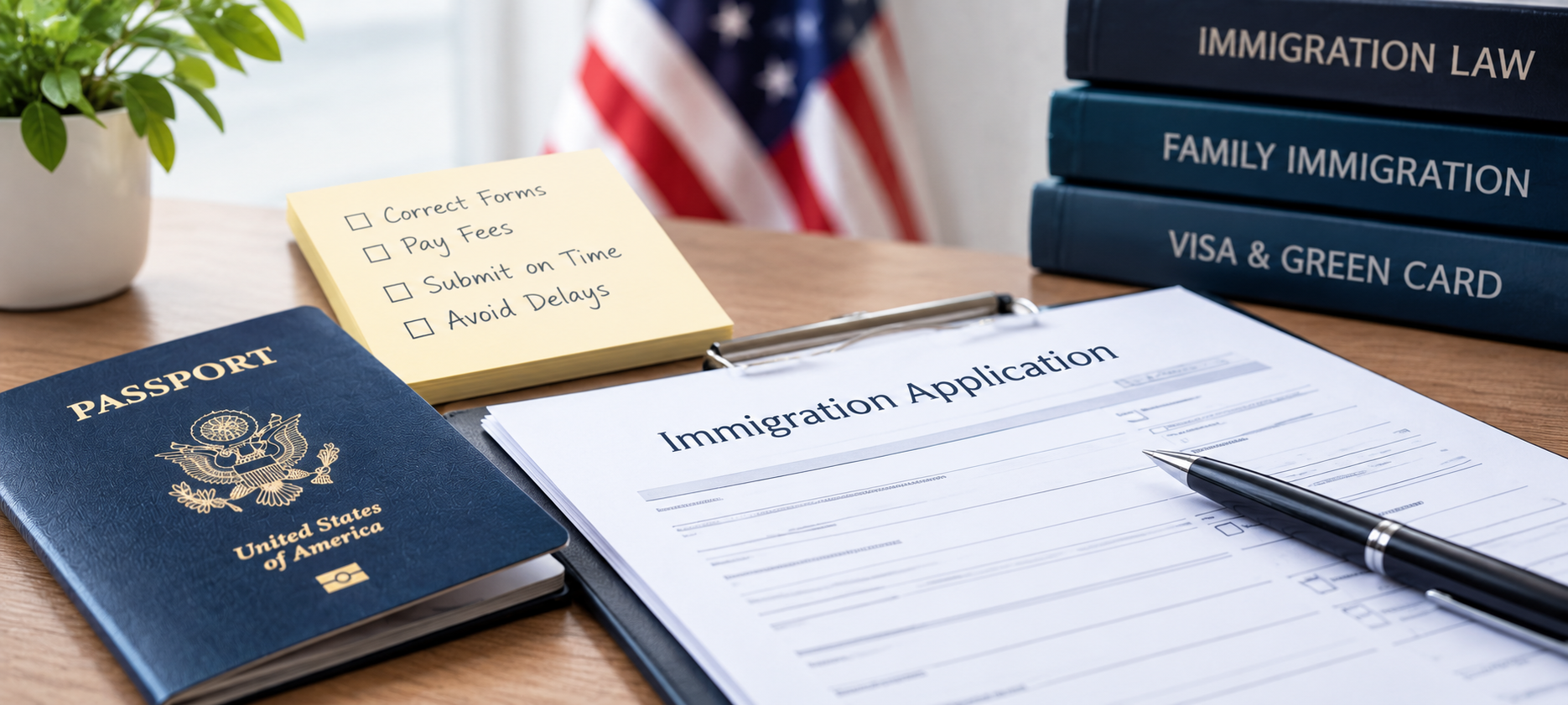
Most people expect their immigration case to take a long time. Few expect to lose months because of a missing signature or an old address.
Many delays come from errors that people could have prevented, not from the government’s backlog. A rejected filing, a missed deadline, or a form that contradicts another form can push a case back by months. In some cases, the damage is more serious than a delay.
This guide covers the immigration mistakes we see most often, why they matter, and how to avoid them. It applies to families in White Plains, the Bronx, and Yonkers as much as to anyone filing from another state or from abroad.
Rejection, Denial, and Delay Are Different Things
People use these words as if they mean the same thing. They don’t, and the difference matters.
A rejection means USCIS returned your filing without deciding it. The agency treats a rejected application as never filed. You lose your place in line and have to start over.
A request for evidence (RFE) means USCIS needs more information before it can decide. Your case stays pending, but the clock slows.
A denial means USCIS decided your case against you. Some denials can be appealed or refiled. Others can lead to more serious consequences.
Most simple filing errors cause rejections. Most substantive errors cause RFEs or denials. Both add time to the immigration processing time you were already dreading.
Mistakes That Get a Filing Rejected
These errors seem small. They are also the easiest to prevent.
Using the wrong form edition
USCIS updates its forms regularly. It generally will not accept an outdated edition once a new one takes effect. Always download the form from the USCIS website on the day you prepare your filing. Do not reuse a copy from a friend or an old email.
Sending the wrong fee
Fees change, and some forms carry more than one fee. Paying too little, paying too much, or writing the check to the wrong payee can all lead to a rejection. USCIS publishes a fee calculator and the current fee schedule. Check both right before you file, because fees can change.
Missing or incorrect signatures
An unsigned form is one of the oldest filing errors. USCIS has strict rules about how signatures must look on paper filings. Ask a qualified professional to review the signature requirements for your form. Do not assume a typed name will pass.
Mailing the package to the wrong location
Many forms have different filing addresses depending on the applicant’s category or location. USCIS changes these addresses from time to time. Confirm the address on the official “Where to File” page for your specific form. Do this on the day you mail the package.
Leaving questions blank
If a question does not apply to you, write “N/A” or “None” as the instructions direct. A blank field can look like an oversight. In some cases, it leads to an RFE or a rejection.
Mistakes That Cause Longer Delays
Rejections usually come back fast. These errors take longer to surface, and they cost more.
Giving inconsistent information across forms
Suppose your I-130 lists one date of entry. Your I-485 lists another. Your passport stamp shows a third. USCIS officers compare your forms against each other, and they compare them against your past filings. Inconsistencies invite questions. Questions mean RFEs, interviews, and delays.
Here is a hypothetical example. A man files for a green card through his U.S. citizen wife. He guesses at the date he first entered the country because he does not have the paperwork in front of him. The date does not match his old visa records. USCIS sends a request for evidence, and the case slows while he tracks down the documents.
Gather your records before you fill out the forms. Do not rely on memory for dates, addresses, and prior immigration history.
Not disclosing prior immigration history, arrests, or past filings
People often leave out an old visa denial, a prior deportation order, or an arrest they think is “too old to matter.” Don’t. USCIS can see much of this history through its own records and background checks. A disclosed problem can often be addressed. An undisclosed problem can look like a misrepresentation, which creates a separate and much harder issue.
If you have any arrest, citation, or prior immigration encounter in your past, speak with an attorney before you file anything.
Submitting weak evidence in marriage-based cases
In a marriage-based case, USCIS wants proof that the relationship is real. A marriage certificate shows that the wedding happened. It does not show the life you share.
Strong evidence usually shows a shared life over time. That can include joint leases or mortgages, shared bank accounts, insurance records, tax returns, and photos across many occasions. If you want to see how the full process fits together, our guide to the Form I-130 petition walks through the evidence and the steps in plain language.
Missing the response deadline on an RFE or notice
An RFE or a notice of intent to deny comes with a deadline printed on it. Miss it, and USCIS can decide your case on the record it already has. That often means a denial.
Open every USCIS envelope the day it arrives. Mark the deadline on a calendar. Then call a lawyer, because the deadline will not wait on you.
Skipping the interview or biometrics appointment
USCIS schedules fingerprinting and interviews by notice. If you cannot attend, ask to reschedule before the date, not after. A missed appointment without a good reason can lead USCIS to treat your case as abandoned.
Not updating your address
Noncitizens in the United States generally must report a change of address to USCIS within 10 days of moving. The agency mails important notices to the address on file. If you moved from Westchester to Brooklyn and told no one, your interview notice may go to an empty apartment.
Update your address with USCIS right away. Also file a change of address for any pending case, because the general address update does not always reach every pending application. Check the USCIS website for the current steps.
Traveling while a case is pending
Leaving the country can create serious problems for some applicants, especially those with a pending green card application. Depending on your status, you may need advance permission from USCIS before you travel. Without it, your application may be treated as abandoned.
Never assume your travel plans are safe. Ask an attorney first.
Working before you have permission
If you have a pending application, that does not automatically mean you can work. Working without authorization can cause trouble that follows you for years. Wait until you hold a valid work permit, or confirm your status allows employment.
A Common New York Trap: Unlicensed “Help”
In New York City and the surrounding counties, many people turn to a neighbor, a travel agent, or a “notario” for help with immigration forms. In many Latin American countries, a notario is a trained lawyer. In the United States, a notary public is not a lawyer and cannot give legal advice or represent you before USCIS.
A person without legal training may choose the wrong form. They may file for a benefit you do not qualify for. They may miss an issue that shows up at your interview. By then, the damage can be hard to reverse.
Before you hire anyone, ask whether they are a licensed attorney or an accredited representative. You can ask for a bar number and check it. A qualified professional will not mind.
How to Avoid Immigration Delays: A Practical Checklist
You cannot control USCIS’s workload. You can control what you send. Before you file, check these points:
- Confirm the form and edition. Download it fresh from USCIS.
- Confirm the fee. Use the official fee schedule and calculator.
- Confirm the filing address. Check the “Where to File” page.
- Sign every required line, and make sure every person who must sign has signed.
- Match your answers across forms. Compare dates, names, and addresses against your records.
- Disclose your history. Include prior filings, entries, and encounters with law enforcement or immigration officers.
- Keep copies of everything. Save the complete package you send.
- Track your deadlines. Write every notice date on a calendar.
- Check your case status. Use your receipt number on the USCIS website.
You can find current USCIS estimates on its official processing times page. These figures vary by form and office, and they change, so treat them as a guide and not a promise. If your case sits well beyond the posted range, you may be able to submit a case inquiry.
Frequently Asked Questions
Filing errors cause many early problems. These include the wrong fee, the wrong form edition, and a missing signature. Beyond those, inconsistent answers and undisclosed history cause the most serious trouble, because they can lead to denials and not just delays.
Sometimes. If USCIS rejects your filing, you can correct it and file again. If you spot an error in a pending case, an attorney can often submit a correction. Whether a fix is available depends on the type of mistake and where your case stands.
It depends on your form, your category, and the office handling your case. USCIS posts current estimates on its processing times page. Check it for your specific form, and verify it again before relying on it.
The law does not require one for most USCIS filings. Still, simple cases can hide complications, such as a past overstay or an old arrest. A short consultation can show you whether your case is as straightforward as it looks. Our post on what an immigration lawyer does and when you need one can help you decide.
Read the deadline first, then gather any documents it requests. Do not ignore it, and do not file anything in response without understanding what the notice asks. Bring the complete notice to an attorney as soon as you can.
It can. A misrepresentation or inconsistent record may follow you into later cases. That’s one reason to get a filing right the first time, especially if you plan to apply for a green card or citizenship down the road.
When to Talk to an Attorney
Some cases are simple. Many are not. If any of these apply to you, speak with a qualified immigration attorney before you file:
- You have ever overstayed a visa or entered without inspection.
- You have an arrest, charge, or conviction, even an old one.
- You have a prior denial, removal order, or immigration court case.
- You received an RFE, a notice of intent to deny, or a court notice.
- You are unsure which form or category fits your situation.
If you are applying through a spouse or relative, our overview of family immigration services explains the main paths. For a broader look at how the system works, read The Complete U.S. Immigration Process: A Realistic Guide for New York Families.
Immigration rules, fees, and procedures change. Everything here is general information, not legal advice for your situation. Verify current requirements on the USCIS website before you file.
If you have questions about your case, E-Z Immigration offers consultations at the White Plains office and by secure video for clients elsewhere. You can reach the team through the contact page or at (914) 946-3191. A conversation before you file costs far less than fixing a mistake afterward.