
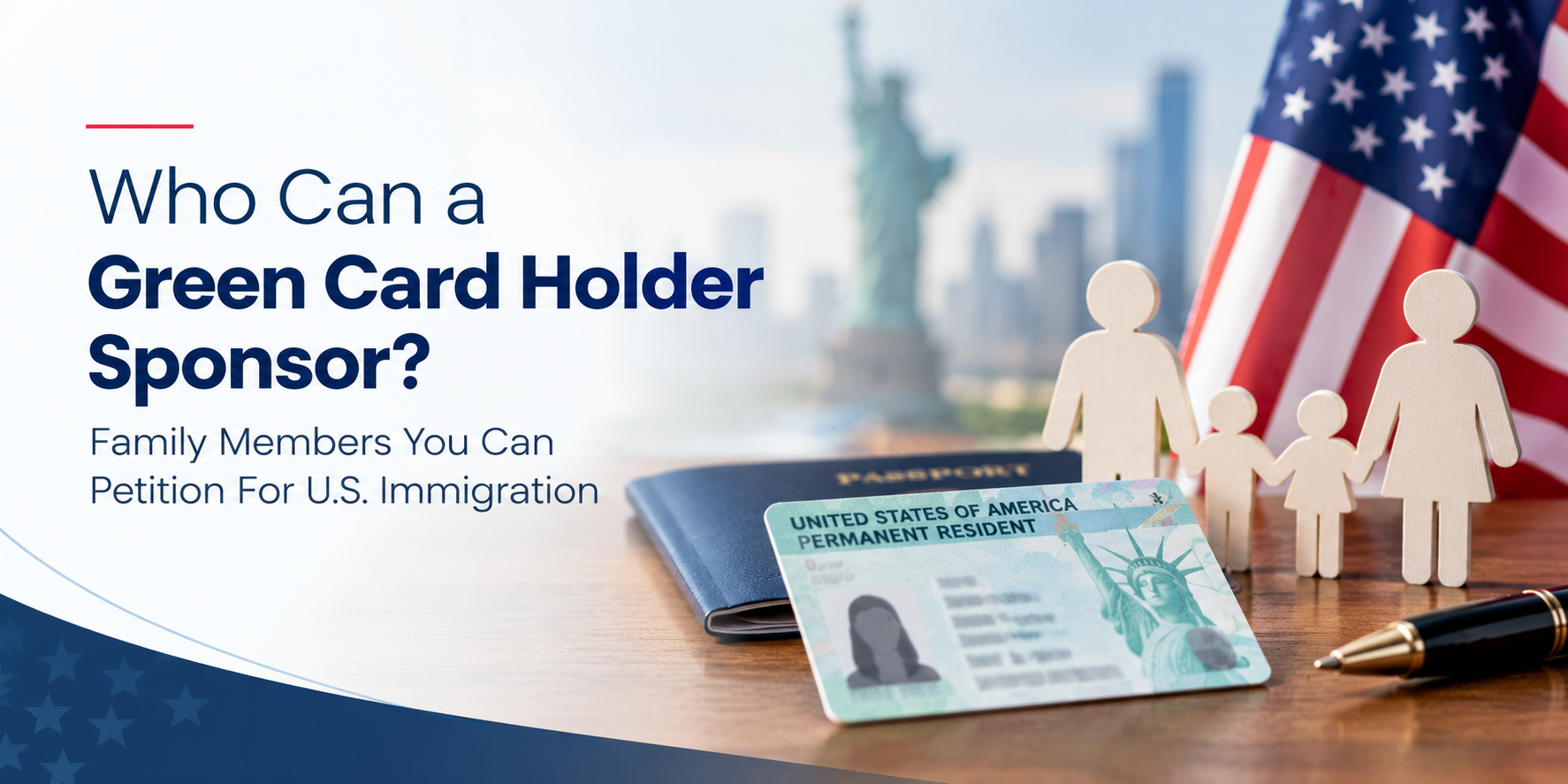
You became a permanent resident, and now you want your family with you. Then the questions start. Can you sponsor your spouse? Your adult son? Your mother? Your brother?
The answer is narrower than many people expect. A green card holder can sponsor family members in only a few categories. Parents and siblings are not among them. This guide explains who you can sponsor, how the waiting line works, and what changes if you become a U.S. citizen. It applies to families across New York and to anyone filing from elsewhere.
The Short Answer
A permanent resident can petition for three groups:
- Your spouse.
- Your unmarried children under 21.
- Your unmarried sons and daughters who are 21 or older.
That’s the full list. You cannot sponsor parents, siblings, or married children while you hold a green card. Those options open only after you become a U.S. citizen.
Immigration law calls this system family preference immigration. It ranks relatives into categories and caps the number of visas each year. That cap creates waiting lines, which is why timing matters so much.
Who a Permanent Resident Can Sponsor
Your spouse (F2A)
A green card holder can sponsor a husband or wife. The category is called F2A. Same-sex marriages count if the marriage is legally valid where it took place.
Your spouse’s unmarried children under 21 can often come along on the same petition. Stepchildren can qualify if the marriage took place before the child turned 18.
Your unmarried children under 21 (F2A)
Your own unmarried children under 21 also fall under F2A. Your child must stay unmarried, and the age requirement matters. A child who turns 21 or marries before getting a green card can lose the original category. Special age-protection rules sometimes help, so ask an attorney if your child is close to 21.
Your unmarried sons and daughters, 21 and older (F2B)
You can sponsor an adult child, but only if that person has never married. This category is called F2B. It usually has a much longer wait than F2A.
A single marriage ends eligibility. Divorce does not bring it back. If your adult child marries, the F2B petition generally cannot continue.
Who You Cannot Sponsor
This is where many families lose time and money. A green card holder cannot sponsor:
- Parents. Only U.S. citizens who are at least 21 can petition for a parent.
- Siblings. Only U.S. citizens can petition for a brother or sister.
- Married children. A permanent resident has no category for them. If you naturalize, married children become eligible under a different category.
- A fiancé(e). The fiancé(e) visa is open only to U.S. citizens.
- Grandchildren, aunts, uncles, cousins, and in-laws. The family system does not cover them.
If you cannot sponsor someone today, that does not mean you never can. Citizenship changes your options a lot.
How the Process Works
Step 1: File the petition
You start by filing Form I-130, Petition for Alien Relative, with USCIS. Spouse cases also include Form I-130A. Guide to Form I-130 walks through the evidence and the steps.
The petition proves your relationship. It does not give your relative a green card by itself.
Step 2: Wait for a visa number
Congress limits how many family preference visas the government can issue each year. Your relative gets a priority date, which is the date USCIS receives your petition. That date holds your place in line.
The State Department publishes the Visa Bulletin each month. It shows which priority dates are current. Dates move forward, stall, and sometimes move backward.
Recently, F2A spouse and child cases have moved close to current for most countries, while F2B adult child cases have waited much longer. The wait also differs by country of birth. Mexico, the Philippines, India, and China often carry different dates. Treat any number you read online as a snapshot, and check the current bulletin before you plan.
The Visa Bulletin has two charts, and the difference confuses people. USCIS tells people already in the U.S. which chart to use each month, and the State Department uses the charts for consular cases. A relative cannot always file or finish a case just because a date looks current. Ask an attorney how the charts apply to your case.
Step 3: Finish the green card process
Once a visa number is available, your relative takes one of two paths:
- Adjustment of status inside the U.S., if the person qualifies to stay and file here.
- Consular processing abroad, with an interview at a U.S. embassy or consulate.
Not everyone can adjust status inside the U.S. A relative who entered without inspection or overstayed may face serious problems. Do not assume a relative can stay and apply. Get legal advice first.
Step 4: Prove you can support your relative
As the sponsor, you must file Form I-864, Affidavit of Support. This is a legal promise to support your relative at a minimum income level. If your income falls short, a joint sponsor can help. Check the current USCIS income guidelines before you file, since they change.
What Happens If You Become a U.S. Citizen
Naturalization changes the picture quickly.
- Your spouse and children under 21 move to the “immediate relative” category. That category has no annual cap and no Visa Bulletin wait.
- Your married children become eligible for sponsorship.
- Your parents become eligible, if you are 21 or older.
- Your siblings become eligible, though their line is long.
Many families ask whether to sponsor now or wait for citizenship. That depends on how long your wait is, when you can naturalize, and your relatives’ situations. No single answer fits everyone.
If you are weighing citizenship, the right order of filings matters. A mistake can cost years, so talk with an attorney before you decide.
A Hypothetical Example
Here is a hypothetical example. A man in Westchester becomes a permanent resident. His wife lives abroad. His 23-year-old son is single. His 25-year-old daughter is married.
He can petition for his wife (F2A) and his single son (F2B). He cannot petition for his daughter yet. If he later naturalizes, his wife’s case may become an immediate relative case and skip the wait. His daughter becomes eligible. But his son’s marriage before approval could end his eligibility under the original category.
This is an invented scenario. Your facts decide your options.
Common Mistakes
- Assuming you can sponsor parents or siblings. You cannot until you naturalize.
- Forgetting that marriage ends eligibility. A child’s marriage can change or end a petition.
- Ignoring a child’s age. Turning 21 can change the category and the wait.
- Skipping the affidavit of support. Weak income documents can delay or derail a case.
- Assuming a relative can stay and apply. Entry and status history decide this, and it is a frequent trap.
- Relying on old Visa Bulletin dates. Check current information every time.
Frequently Asked Questions
Can a green card holder sponsor a parent?
No. Only a U.S. citizen who is at least 21 can petition for a parent. After you naturalize, your parents can qualify as immediate relatives.
Can I sponsor my spouse and children together?
Often, yes. Your spouse’s unmarried children under 21 can usually be included. Your own children under 21 can also qualify under the same category. Confirm the details for your family with an attorney.
How long does it take?
It varies by category, country of birth, and government workload. Spouse and minor child cases have recently moved faster than adult child cases. Check the current Visa Bulletin and USCIS processing times, and treat any estimate as a guide.
What if my child marries while the petition is pending?
For an unmarried adult son or daughter in F2B, marriage generally ends eligibility under that category. For a child under 21 in F2A, marriage also removes the child from that category. If this might happen, speak with an attorney right away.
What happens to the petition if I become a citizen?
For a spouse or child under 21, the case generally moves to the immediate relative category, and the Visa Bulletin wait ends. For an adult child, the category changes too. Tell your attorney before you naturalize so the timing works in your favor.
Do I need a lawyer to file an I-130?
The law does not require one, and some families file on their own. Problems in a relative’s history or confusion about categories and dates can cause costly delays. Our article on what an immigration lawyer does and when you need one can help you decide.
Practical Next Steps
Start by listing your relatives and writing down each person’s age and marital status. Then check which category fits each one. Gather proof of your own status, such as your green card, along with civil documents like marriage and birth certificates.
For more on the family-based options we handle. For a wider view of visa types, read our guide to U.S. immigration visas.
Immigration rules, visa availability, fees, and policies change often. This article offers general information, not legal advice. Verify current requirements on the USCIS and State Department websites before you file.
If you want to bring family members to the United States, speak with a qualified immigration attorney before you file. E-Z Immigration offers consultations at its White Plains office and by secure video. Reach the team through the contact page or at (914) 946-3191.