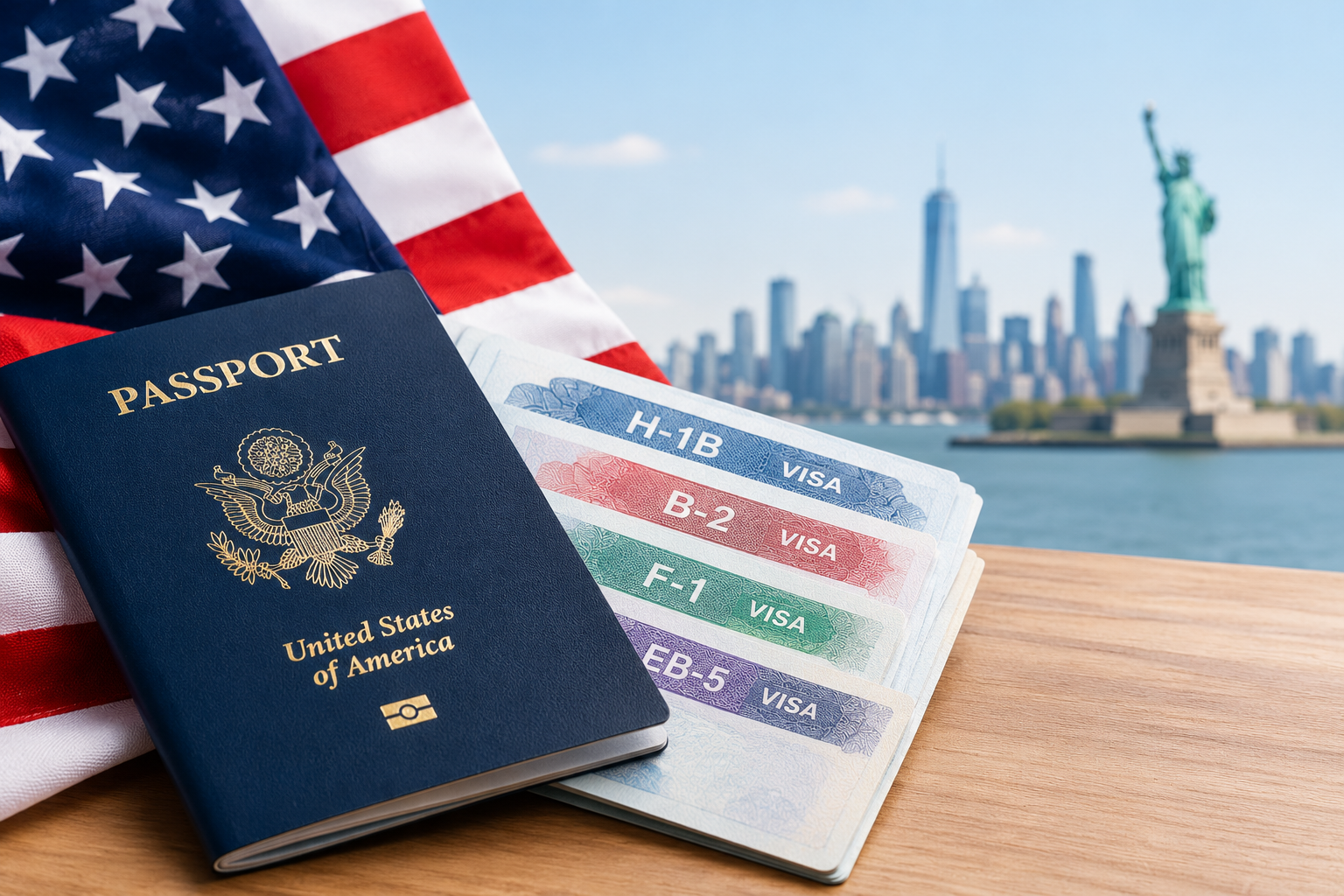
Maybe your sister wants to move to New York. Maybe your company wants to hire an engineer from abroad. Maybe you are in the country now and wonder whether your visa can lead to a green card. You search for the types of US visas and find a wall of letters: H-1B, F-2A, EB-3, K-1, TN.
Here is the short answer. U.S. visas fall into two groups. Immigrant visas lead to permanent residence (a green card). Nonimmigrant visas cover temporary stays, such as tourism, study, or a work assignment. Within each group, the category depends on why you want to come, and sometimes on who is sponsoring you.
The rest of this guide explains the main US immigration visa types, how they differ, and where people usually go wrong.
First, a Few Terms That Cause Confusion
Visa means the document, usually a stamp in a passport, that lets you ask to enter the U.S. at a port of entry. A visa does not decide how long you can stay.
Status is your legal category once you are inside the country. Your I-94 record shows how long you may stay.
Green card means lawful permanent residence. It lets you live and work in the U.S. long term.
Many people mix these up. Someone can hold an expired visa stamp and still be in valid status. Someone else can hold a valid visa and be out of status. The difference matters for almost every application.
Immigrant Visas: Paths to a Green Card
Most immigrant visa categories fall into four groups.
Family-based categories
A U.S. citizen or green card holder files a petition for a relative. The law splits relatives into two types.
Immediate relatives of U.S. citizens have no annual numerical limit. This group includes:
- Spouses of U.S. citizens
- Unmarried children under 21
- Parents of citizens who are at least 21
Family preference categories have annual limits, so waits can be long. They include:
- Adult unmarried children of citizens (F1)
- Spouses and unmarried children of green card holders (F2A and F2B)
- Married children of citizens (F3)
- Siblings of citizens (F4)
Preference categories use a priority date, which is your place in line. The State Department’s monthly Visa Bulletin shows which dates are current. Waits vary by category and by country of birth, so check the latest bulletin instead of relying on old numbers.
The process starts with Form I-130. Our guide to Form I-130 walks through that petition. Our Family Immigration Services covers marriage green cards, parent petitions, and related matters.
Employment-based categories
These come in five preference levels:
- EB-1: People with extraordinary ability, outstanding researchers, and certain multinational managers.
- EB-2: Professionals with advanced degrees or exceptional ability. This category includes the National Interest Waiver.
- EB-3: Skilled workers, professionals, and other workers.
- EB-4: Certain “special immigrants,” such as some religious workers.
- EB-5: Investors who meet the program’s requirements.
Many EB-2 and EB-3 cases begin with PERM labor certification. In PERM, an employer shows the Department of Labor that it tested the job market first. Some categories, like EB-1 extraordinary ability and the National Interest Waiver, skip that step.
Diversity Visa
The Diversity Visa program is a lottery. Only people from eligible countries can enter, and winners must still meet education or work-experience rules. The program has strict annual entry rules and many scams, so use only the State Department’s official site.
Humanitarian and special categories
Some people qualify because of what they have been through, not because of a sponsor. Examples include:
- VAWA: Certain abused spouses, children, and parents of U.S. citizens or green card holders.
- Special Immigrant Juvenile Status: Certain children who cannot reunite with a parent because of abuse, neglect, or abandonment.
- U visa: Victims of certain crimes who help law enforcement. This is technically a temporary status, but it can lead to a green card.
These cases are sensitive and fact-specific. Anyone who thinks they might qualify should talk to an attorney in confidence.
Nonimmigrant Visas: Temporary Stays
Nonimmigrant visas have a purpose and a time limit. The main groups include:
Visitors (B-1 and B-2). B-1 covers short business trips. B-2 covers tourism and medical visits. Neither allows employment.
Students (F-1 and M-1) and exchange visitors (J-1). These come with strict rules about school enrollment, work permission, and, for some J-1 holders, a home-country requirement. New York’s universities draw many students, and this is often the first visa category a family deals with.
Temporary workers. This is the biggest and most technical group:
- H-1B: Specialty occupations that usually require a bachelor’s degree or higher. Annual caps apply to most new petitions.
- L-1: Employees transferring within a multinational company.
- O-1: People with extraordinary ability in fields like science, arts, business, or athletics.
- E-2: Treaty investors and their employees, available only to citizens of certain countries.
- TN: Certain professionals from Canada and Mexico.
- H-2A and H-2B: Temporary agricultural and non-agricultural workers.
K-1 fiancé visa. This visa lets the fiancé(e) of a U.S. citizen enter to marry within 90 days. After the wedding, the new spouse applies for a green card. Although it is a nonimmigrant visa, it is built to lead to permanent residence.
Other categories exist for diplomats, journalists, religious workers, and trafficking victims. The State Department publishes a full directory.
How to Figure Out Which Visa Fits
Start with these questions:
- What is your goal? A short visit, a job, a degree, or a permanent life in the U.S.?
- Who can sponsor you? A relative, an employer, a school, or no one?
- Where are you now? Inside the U.S. or abroad? This decides whether you will use adjustment of status or consular processing.
- What is your history? Prior overstays, denials, arrests, or visa misstatements can change everything.
Here is a hypothetical example. A woman in Westchester is a U.S. citizen. Her brother lives abroad, and her mother is a green card holder with a married son overseas. The brother falls under F4, the siblings category. The married son has a different category and a different wait. The family may assume they will “all come together.” In fact, their timelines can be years apart.
Common Mistakes and Misunderstandings
Using a visitor visa to stay. B-2 visitors who plan to marry, work, or settle in the U.S. can face serious problems. Officers may question whether the person misrepresented their intent at entry. If you are considering a change, talk to an attorney before you travel.
Assuming a visa is a green card. Most temporary visas do not lead to permanent residence on their own. Some, like H-1B and L-1, allow what lawyers call “dual intent.” You can pursue a green card while holding that status. Others, like F-1, do not offer the same flexibility.
Ignoring status expiration. Overstays can trigger unlawful presence bars of three or ten years once you leave the U.S. Some people, especially certain immediate relatives of U.S. citizens, can still fix their status. The rules are technical, and a wrong move can lock you out.
Guessing from internet forums. Immigration law changes, and what worked for a friend may not fit your facts.
Trusting unauthorized help. Notario fraud is a real problem in immigrant communities across New York. Only licensed attorneys and accredited representatives can give legal advice on immigration matters.
Possible Complications
Even clear-cut cases can hit snags:
- Visa backlogs for certain countries and categories
- Requests for Evidence from USCIS
- Prior immigration violations, criminal history, or health-related issues
- Changes to cap rules, fees, filing procedures, or travel restrictions
Policies shift through new regulations and executive actions. Always check current instructions on the USCIS and State Department sites before you file.
What Happens After You Choose a Category
The steps depend on the visa. A typical path looks like this:
- A sponsor, such as a relative or employer, files a petition with USCIS. Some categories allow self-petitioning.
- USCIS reviews and approves the petition.
- If a visa number is needed, you wait for your priority date.
- You apply through consular processing at a U.S. embassy abroad, or by adjustment of status if you qualify to stay in the U.S.
- You attend an interview or biometrics appointment, and the government decides.
For a fuller view of what to expect at each stage, see our realistic guide to the U.S. immigration process for New York families.
Frequently Asked Questions
An immigrant visa leads to permanent residence. A nonimmigrant visa allows a temporary stay for a specific purpose.
Sometimes. It depends on your category, your sponsor, your immigration history, and whether you maintained status. Some temporary statuses allow it more easily than others.
No category is always fastest. Immediate relatives of U.S. citizens avoid annual caps, but processing still takes time. Wait times differ by category, country, and workload, so check the current USCIS and State Department information.
No. You must file the right forms, prove the marriage is genuine, and meet admissibility requirements. Some applicants also need waivers.
No. B-1 and B-2 visitors cannot work. Violating this can cause problems with future applications.
Not every case requires one. But if you have prior overstays, denials, criminal history, or a complicated family situation, an attorney can spot problems before they become costly.
Next Steps
If you are weighing your options, start by listing your goal, your current status, and any prior immigration history. Gather your passport, I-94 record, past applications, and any government notices.
Then speak with a qualified immigration attorney. The first conversation often changes the plan, because one detail can open or close a path.
E-Z Immigration helps individuals, families, and employers across New York and beyond. The White Plains office offers secure virtual consultations. If you have questions about US immigration visa types or which category fits you, you can contact the team or call (914) 946-3191 to talk through your situation.
This article gives general information, not legal advice. Immigration rules, fees, and processing times change. Confirm current requirements with USCIS, the U.S. Department of State, or an attorney before you file.